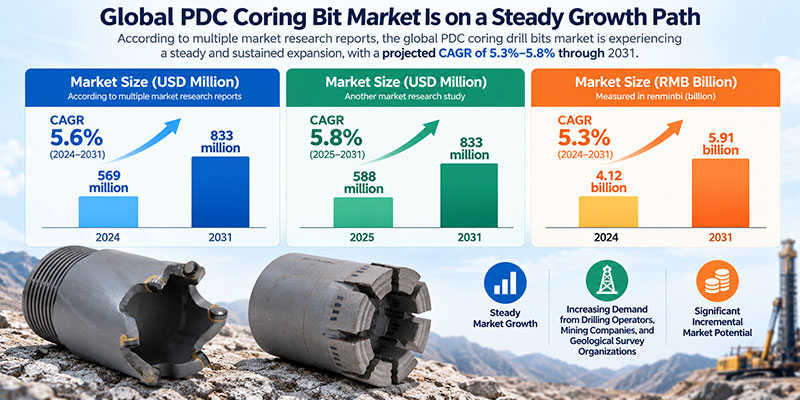
 The global coring industry is undergoing a quiet but consequential transformation. While many still equate advanced drilling technologies primarily with full-hole PDC bits used in oil and gas production, the coring bit segment—specifically PDC coring bits—is experiencing a steady and sustained expansion. According to multiple market research reports, the global PDC coring drill bits market was valued at approximately US569 million in 2024, and is projected to grow to USD833 million by 2031, representing a compound annual growth rate (CAGR) of 5.6%. Another study values the market at US$588 million in 2025, with a projected CAGR of 5.8%through 2031. When measured in renminbi, the market size reached approximately 4.12 billion yuan in 2024 and is forecast to approach 5.91 billion yuan by 2031 at a CAGR of 5.3%.
These figures are not merely statistical abstractions. They represent a fundamental shift in how drilling operators, mining companies, and geological survey organizations evaluate the economics of their coring operations. But to truly understand whether this market is poised for a new growth cycle—and how much incremental potential remains—we need to examine both where we have come from and what lies ahead.
Where We Were Five Years Ago: A Market in Transition
Looking back five years, the coring bit landscape looked noticeably different. Traditional impregnated diamond core bits and surface-set diamond bits still commanded a substantial share of the market. These tools, while reliable in certain applications, carried significant operational penalties. Their rate of penetration (ROP) was modest—typically less than 2 meters per hour in hard formations—and their cost structure was heavily weighted toward frequent bit changes. A conventional diamond core bit might achieve a total drilled life of approximately 11.6 meters before requiring replacement, while early-generation PDC coring bits delivered around 25.2 meters.
The historical choice between PDC and other core bit technologies was often framed as a trade-off between upfront cost and performance. PDC bits were more expensive to purchase—sometimes 4 to 15 times the price of conventional carbide or steel-tooth bits—but their superior durability and drilling speed often made them the more economical choice over the full life of a project. The challenge was that many operators, particularly in price-sensitive sectors like mineral exploration and water well drilling, lacked the data or confidence to shift their procurement patterns.
Over the past five years, that hesitation has steadily eroded. Major manufacturers—including Sandvik, Epiroc, Dimater, Diaset, Hard Core Diamond, and China-based players such as Great Drill Bits, Ruishi Bits Manufacturing, Chuanshi Diamond Bit, Hanfa Group, and Deepbit—have refined PDC cutter technology, improved thermal stability, and expanded product lines to cover a wider range of formation types. The result is a market where PDC coring bits are no longer perceived as a premium specialty product but as a mainstream, cost-effective solution across multiple end-use sectors.
What Buyers Actually Care About: Five Core Concerns
For any drilling operator or procurement manager evaluating PDC coring bits, the decision ultimately comes down to five practical questions. Understanding these concerns helps explain both the market's past growth and its future trajectory.
1. Efficiency and Rate of Penetration (ROP)
The single biggest driver of coring economics is how fast the bit cuts. In conventional drilling operations—whether for mineral exploration, geothermal wells, or oil and gas coring—rig time represents the largest variable cost. A bit that drills faster reduces total operating hours, lowers fuel consumption, and frees equipment for other projects. Modern PDC coring bits deliver ROP values of 3 to 6 meters per hour in common formations such as shale, sandstone, and limestone. In vertical sections, PDC bits have been documented achieving up to four times the penetration rates of conventional TCI bits. For operators accustomed to slower diamond core bits, this difference translates directly into project acceleration.
2. Longevity and Total Drilled Life
A bit’s upfront price is only half the equation. The other half is how many meters it can drill before needing replacement or refurbishment. Here, the data speaks clearly. PDC coring bits typically offer approximately 4 to 5 times the useful life of conventional diamond bits and at least 10 times the life of tungsten carbide bits. In geothermal applications, a comparative field test showed conventional PDC bits achieving 25.2 meters of drilled length, new-generation PDC bits reaching 32.2 meters, and standard surface-set diamond bits only 11.6 meters. That 2.8-to-1 difference in service life explains why experienced buyers have increasingly shifted toward PDC technology.
3. Cost Per Meter and Total Cost of Ownership
End users rarely fixate on bit price alone. They calculate cost per meter. The formula is straightforward: (Bit Cost + Rig Cost per Hour × Hours on Bit) ÷ Meters Drilled. In one documented geothermal comparison, switching to a PDC coring solution reduced drilling costs by approximately 36% compared to using roller cone bits. This is not theoretical. It is verified field economics.
4. Formation Compatibility and Core Integrity
Not every bit works in every rock. Buyers need tools matched to specific geological conditions—soft clay, medium-hard sandstone, abrasive granite, or fractured formations. PDC coring bits excel in medium-hard to hard rock formations, particularly where high coring rates and core recovery are essential. Their “micro-cutting” mechanism preserves core integrity better than crushing-based roller cone bits, and their design—including coring channels and stable guide devices—ensures high coring recovery rates.
5. Maintainability and Refurbishment Potential
No bit lasts forever, but some bits can be economically restored. Professional repair services can return a worn PDC core bit to over 90% of its original performance through cutter replacement and re-tipping operations. Sharpening and redressing—removing a thin layer of worn cutter material—are standard maintenance practices that extend operational life. With proper care, including thorough cleaning after each run and regular inspection for cracks or matrix separation, PDC bits can achieve significantly extended service intervals. This refurbishment ecosystem gives buyers a clear path to reducing their long-term consumables budget while maintaining drilling performance.