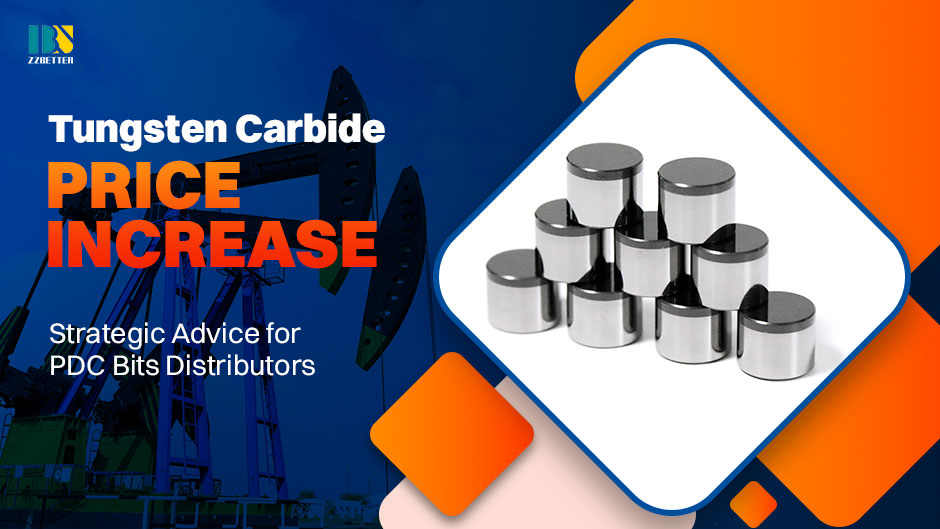
If you're a PDC bits distributor, you've likely felt the pinch in recent months. The raw materials that form the backbone of your products—tungsten carbide and cobalt—are experiencing unprecedented price volatility. According to the latest data from China Tungsten Online, as of March 3, 2026, tungsten carbide powder is now priced at RMB 1,940/kg, representing an 86.5% increase since the beginning of the year. Cobalt powder has also risen 11.5% during the same period .
This isn't just a market fluctuation—it's a structural shift. Tungsten's status as a strategic critical mineral, combined with supply-side constraints and increased capital allocation preferences, has driven raw tungsten material prices up approximately 85% in just two months. Scrap tungsten drill bits are now commanding RMB 1,300/kg, up an astonishing 124.1% from the start of 2026.
For PDC bits distributors, these numbers translate directly to margin pressure, pricing challenges, and the need for strategic adaptation. Here's how to navigate this high-cost environment while maintaining your competitive edge.
1. Rethink Your Product Mix: The Matrix Body Advantage
When tungsten carbide prices soar, the conversation about bit body materials becomes critical. Matrix body PDC bits, which use a tungsten carbide-based composite material, have traditionally commanded higher upfront costs than steel body alternatives. However, the value proposition has shifted.
Matrix body bits offer 30% better abrasion resistance than steel and superior gauge retention in abrasive formations. More importantly, they deliver longer run lengths—which means fewer bit trips, reduced downtime, and lower overall cost per foot drilled. In today's high-cost environment, distributors should emphasize total cost of ownership (TCO) rather than initial purchase price.
The key message for your customers: while matrix body bits may cost more upfront, they deliver superior economics in abrasive formations by staying on bottom longer and reducing non-productive time.
2. Educate Your Customers on Cost-per-Foot Economics
One of the most valuable services you can provide as a distributor is helping customers understand the true economics of their drilling operations. When tungsten carbide prices spike, some operators may be tempted to downgrade to cheaper bits. This is precisely the wrong move.
High-quality PDC bits with premium carbide grades and advanced cutter technology deliver:
- Longer service life: Up to 800+ meters in limestone versus 200-400 meters for conventional options
- Higher ROP: 25-40% improvement in penetration rates
- Reduced downtime: 35% fewer interruptions from bit changes
When you translate these operational benefits into dollars, the math becomes clear. A premium bit that costs more but drills twice as far and 30% faster delivers dramatically lower cost per meter drilled. In today's market, that's a conversation worth having with every customer.
3. Explore Alternative Material Strategies
The current price environment is also driving innovation in material science. Research projects are exploring lower-cost alternatives to traditional tungsten carbide matrices. For example, the Norwegian research project "LoCo2" has been developing silicon carbide (SiC) particles coated with thin tungsten carbide layers as a potential lower-cost alternative for drill bit bodies.
While these technologies are still emerging, they signal a future where material costs may be optimized through hybrid approaches. Forward-thinking distributors should stay informed about these developments and be ready to evaluate new products as they reach commercial viability.
4. Optimize Inventory Management
In a volatile pricing environment, inventory strategy becomes a competitive weapon. Consider these approaches:
- Strategic stockpiling: If you have the capital and storage capacity, building inventory during price dips can protect your margins when prices rise
- Just-in-time adjustments: Conversely, if prices are peaking, minimize inventory carrying costs and order only for confirmed orders
- Scrap recycling programs: With scrap tungsten drill bits commanding RMB 1,300/kg, consider offering customers a trade-in program for worn bits. Recovered tungsten carbide can be recycled, reducing your raw material costs by up to 25%
5. Strengthen Supplier Relationships
Not all PDC bits are created equal, and not all manufacturers have the same cost structures or quality standards. In a high-price environment, the quality of your supply chain matters more than ever.
Look for manufacturers with:
- Consistent powder composition and quality control during sintering
- High-density tungsten carbide matrices that maximize wear resistance per unit of material
- Premium PDC cutters with strong thermal resistance that protect your investment downhole
Poor manufacturing can lead to internal voids, weak cutter support, and premature body cracking. When material costs are high, you cannot afford failures caused by manufacturing defects.
6. Communicate Value, Not Price
Finally, remember that your customers are facing the same cost pressures you are. They need solutions that help them manage their total drilling economics, not just the lowest invoice price.
Position yourself as a partner who understands their challenges and provides solutions that:
- Reduce total cost per foot drilled
- Minimize non-productive time from bit trips
- Deliver predictable performance in challenging formations
- Offer customization for specific applications
In abrasive formations, interbedded geology, or directional drilling applications, the right PDC bit isn't an expense—it's an investment in operational efficiency.
Conclusion: Adapt and Thrive
The tungsten carbide price surge of 2026 is real, and it's reshaping the economics of PDC bit distribution. But challenges also create opportunities. Distributors who adapt their product mix, educate their customers, optimize inventory, and strengthen supplier relationships will not only survive—they'll gain market share.
The key is shifting the conversation from price to value. When your customers understand that the right bit delivers lower cost per foot, fewer trips, and faster ROP, the upfront cost becomes secondary to the bottom-line result.
Need expert guidance on selecting the right PDC bits for your customers' applications? Contact our team today for personalized recommendations and competitive pricing.