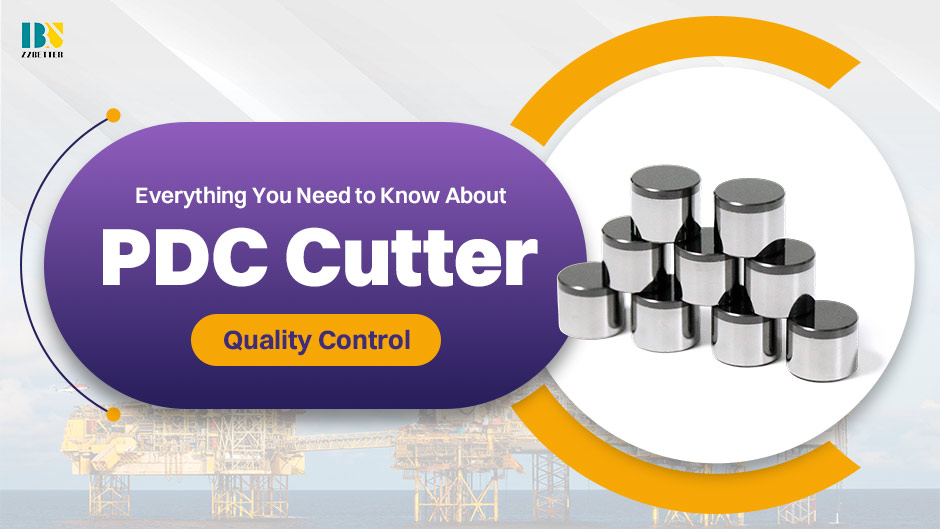
Why Uncompromising Quality Assurance Separates Market Leaders from the Rest
In the brutal world of oil and gas drilling, geothermal exploration, and hard rock mining, the difference between a profitable well and a financial disaster often comes down to a single component no larger than a coin: the PDC (Polycrystalline Diamond Compact) cutter.
These "teeth" of the drill bit must withstand extreme impact, intense abrasion, and temperatures that can exceed 700°C. Yet, the harsh reality is that not all PDC cutters are created equal. Even within the same batch, hidden defects can lead to catastrophic delamination, premature wear, and costly downtime.
This is where rigorous quality control becomes the true differentiator. For professionals who demand reliability, understanding how a cutter is made—and how it is tested—is essential. In this guide, we will walk you through the seven pillars of PDC cutter quality control and show you why zzbetter has become the trusted name in high-performance drilling tools.
The Hidden Cost of Inconsistent Quality
Before diving into test methods, let's understand the stakes. A single failed PDC cutter often means pulling the entire drill string out of the hole—a process that can cost anywhere from $20,000 to over $100,000 per day, depending on the rig and depth.
The most common failure modes are not simple wear, but impact fracture and non-normal wear, such as chipping or spalling. Even worse is delamination —the separation of the diamond table from the tungsten carbide substrate. Once delamination occurs, the cutter loses its cutting edge immediately, and drilling efficiency plummets.
The 7 Critical Dimensions of PDC Cutter Quality Control
1. Raw Material Incoming Inspection
Quality begins with the powder. Top-tier manufacturers, including zzbetter, perform strict purity and particle size analysis on both diamond micron powder and the tungsten carbide substrate. Any microscopic impurity can become a stress concentration point during the high-pressure, high-temperature (HPHT) sintering process.
ZZbetter standard: We reject any batch of raw material that does not meet our certified particle distribution and purity specifications.
2. Abrasion Resistance Ratio (Wear Test)
This is the gold standard for measuring wear resistance. The test involves grinding a PDC cutter against a standard grinding wheel under controlled conditions. The ratio of cutter weight loss to wheel weight loss defines the abrasion resistance. The higher the ratio, the longer the cutter will last in abrasive formations like sandstone.
3. Impact Toughness
Downhole conditions are never smooth. Vibration, whirl, and stick-slip phenomena subject cutters to repeated impacts. The drop-weight impact test simulates this by repeatedly striking the cutter with increasing energy levels (e.g., from 40J to failure).
4. Thermal Stability
Heat is the enemy of PDC cutters. During cutting, friction generates temperatures that can cause residual cobalt catalyst to expand, cracking the diamond lattice from within.
Standard test: Heat the cutter to 700–750°C, hold for 10–15 minutes, cool naturally, then retest abrasion resistance. If performance drops significantly, thermal stability is poor.
5. Ultrasonic C-Scan
This is the most powerful non-destructive testing method available. Using high-frequency ultrasound (0.2–800MHz), C-Scan can see inside the diamond table and the interface between diamond and carbide. It detects:
• Internal voids or porosity
• Delamination
• Cracks invisible to the naked eye
Every zzbetter batch includes C-Scan records —not just for a sample, but for statistically significant lots. This guarantees interface integrity.
6. Residual Stress Measurement
After HPHT sintering, the diamond layer and carbide substrate cool at different rates, creating residual internal stresses. These "time bombs" can cause spontaneous failure under thermal cycling.
7. Real-World Cutting Test
No amount of lab data replaces actual cutting. zzbetter conducts granite turning tests , where cutters are mounted on a lathe and run against hard granite until failure. This simulates the most extreme downhole conditions with no cooling fluid.
From Laboratory to Field: The zzbetter Difference
Understanding QC methods is one thing. Implementing them consistently is another. Many manufacturers talk about quality. zzbetter delivers it.
Zero-Compromise Outgoing Inspection
Before any shipment leaves our facility, it must pass a final audit:
• 100% dimensional inspection
• Batch-level C-Scan sampling
• Abrasion ratio verification
• Impact test certification
Why Choose ZZbetter for Your Drilling Operations?
If you are a procurement manager, drilling engineer, or tool fabricator, you need more than a datasheet. You need confidence.
Confidence that every cutter in the box will perform identically to the one tested.
Confidence that thermal stability won't fail halfway through a critical run.
Confidence that your supplier stands behind every single piece.
That confidence is what zzbetter delivers. Our PDC cutters are not just high-performance—they are consistently high-performance, batch after batch, year after year.
Quality is Not an Accident
When you choose zzbetter, you are choosing a partner who understands that the cost of a single field failure far outweighs the cost of rigorous testing. You are choosing traceability, transparency, and technical excellence. Don't let hidden defects cost you a fortune. Demand zzbetter quality.