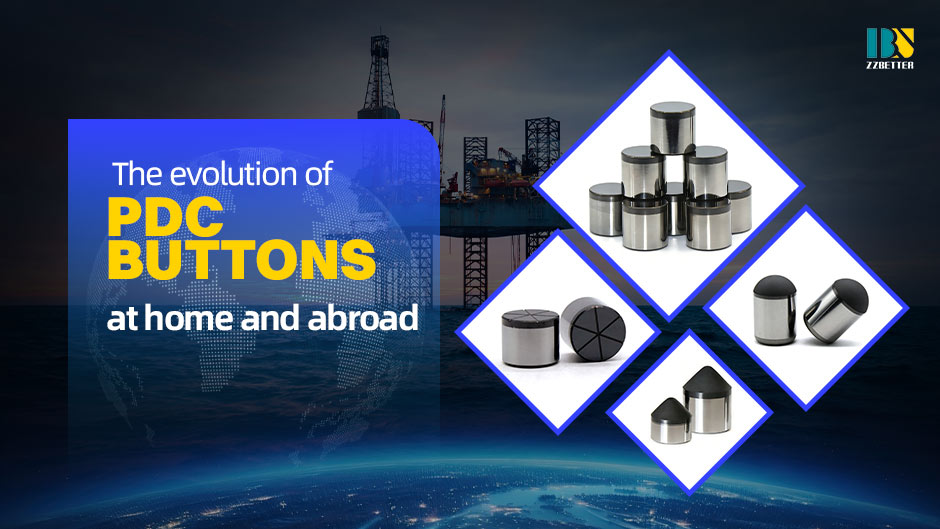
 In the relentless pursuit of efficiency and durability in drilling and cutting, few tools have sparked as significant a revolution as the PDC (Polycrystalline Diamond Compact) button. Known in Chinese as 金刚石复合齿, this ingenious tool—typically a spherical dome—marries the impact resistance of a tungsten carbide substrate with the unparalleled hardness and wear resistance of a synthetic diamond layer. Its development history is a compelling narrative of international scientific ambition, parallel breakthroughs, and global technological convergence, ultimately transforming industries from deep-earth mining to infrastructure construction.
The story begins not with the button, but with the diamond itself. The international drive for PDC technology was ignited in the 1970s, primarily in the United States. Following the successful synthesis of diamond grit, researchers at entities like General Electric pioneered the high-pressure, high-temperature (HPHT) process to fuse a layer of micron-sized synthetic diamond crystals directly onto a cemented tungsten carbide substrate. The initial goal was to create durable cutting elements for the oil and gas industry. These early, often flat-faced PDC cutters were a breakthrough, but their application in percussive or abrasive environments was limited. The conceptual leap to a spherical "button" geometry—most commonly the dome—was transformative. This shape offered superior brazing strength, optimal stress distribution, and self-sharpening characteristics as it wore, making it ideal for the brutal, impact-heavy world of mining and geological drilling. Through the 1980s and 1990s, Western companies relentlessly refined the interface bonding technology, diamond layer microstructure, and substrate composition, establishing a dominant position in high-end markets.
In China, the development of PDC buttons followed a distinct yet determined trajectory, catalyzed by both necessity and national strategic interest. While international progress was noted, China's journey was largely one of independent research and industrialization from the 1980s onward. Key research institutes and state-owned enterprises took on the challenge of mastering the complex HPHT synthesis technology. The initial phase was marked by overcoming significant technical hurdles in achieving a stable, non-delaminating diamond-to-carbide bond. Early domestic PDC products, often seen as less consistent than their foreign counterparts, found initial application in softer rock formations and lower-intensity construction work.
However, the turn of the 21st century marked a pivotal point of convergence and accelerated advancement for Chinese PDC button technology. Driven by explosive domestic demand from the mining and infrastructure sectors, and fueled by significant investment in R&D, Chinese manufacturers embarked on a remarkable journey of quality enhancement and innovation. This period saw the systematic improvement of raw material purity, the precision of the HPHT process, and the introduction of advanced leached technology to create thermally stable PDC (TSP) variants. Chinese engineers not only closed the technological gap but also began innovating in areas like multi-layered composite structures and specialized geometries tailored for specific Chinese rock formations. Today, China is not just a massive consumer but a leading global producer and exporter of PDC buttons, with its products competing on the world stage in terms of both performance and cost-effectiveness.
The development history of the PDC button is thus a tale of two parallel paths that have now merged into a single, fast-moving highway of progress. From its origins in American laboratories to its mastery and mass-production in Chinese factories, the PDC dome button stands as a testament to global engineering ingenuity. It evolved from a novel, expensive cutting element to a ubiquitous, indispensable tool that drives the very foundations of modern industry. As we look to the future, the next chapters of this history will be written in the language of nanotechnology, intelligent design, and custom-engineered solutions for ever-more challenging environments, with both domestic and international innovators continuing to push the boundaries of what this tiny, super-hard composite tooth can achieve.