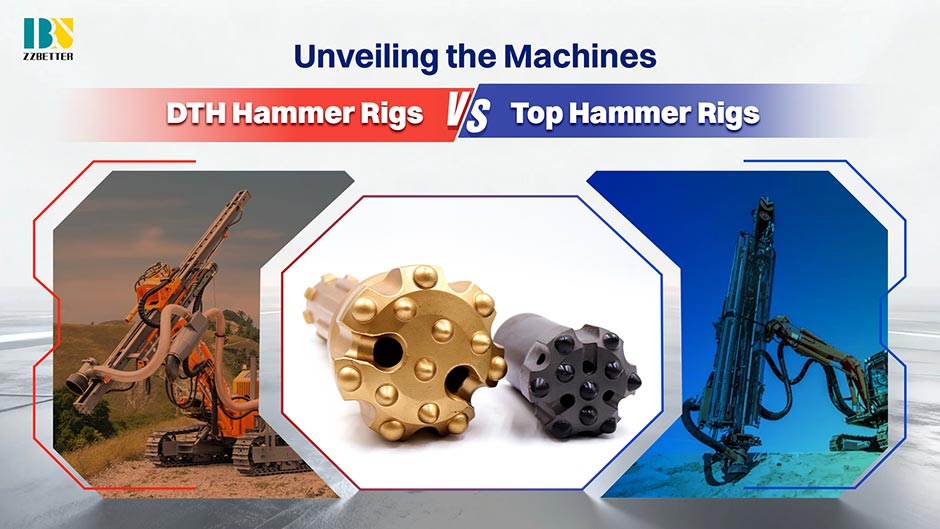
The world of rock drilling relies on two dominant, yet fundamentally different, technologies to fragment and penetrate the earth: Down-The-Hole (DTH) hammer drilling and Top Hammer drilling. At first glance, they might seem similar—both are percussive methods—but the core distinction lies in the location of the percussive mechanism and the machinery that enables it. Understanding this machinery is key to grasping their subsequent applications.
The Down-The-Hole (DTH) Hammer Rig: Power at the Bottom
A DTH drilling system is centered around a rotary drill rig, often a robust, crawler-mounted or truck-mounted platform. Its most critical auxiliary component is a high-pressure, high-volume air compressor (typically in the 250 to 1200+ CFM range at pressures of 100 to 350+ psi). This compressor is the lifeblood of the operation.
The magic happens at the end of the drill string. The DTH hammer itself is a sophisticated pneumatic (or sometimes hydraulic) piston mechanism housed in a steel cylinder. It is attached directly to the bottom of the drill pipe, with the drill bit threaded into its front end. High-pressure air is sent down the annular space between the inner and outer walls of the drill pipe (or through a dedicated channel) to activate a reciprocating piston inside the hammer. This piston strikes the drill bit's shank directly, thousands of times per minute. The rig's primary functions are to provide constant rotation to the entire string, maintain optimal feed (downward) pressure, and handle the pipes. The hammer, isolated at the bottom, does all the percussive work exactly where it's needed: at the rock face.
The drill string for DTH is relatively simple, consisting of standard or heavy-walled drill pipes with regular threaded connections. Their main job is to transmit rotation, feed force, and compressed air, not percussive shockwaves.
The Top Hammer Rig: Power at the Top
In stark contrast, a Top Hammer system integrates the percussive power directly into the rig. The primary machine is a hydraulic rock drill (or, in older models, a pneumatic one) mounted on a sliding feed beam. This entire assembly is attached to a carrier—be it a tracked "jumbo" for underground mining/tunneling, a self-propelled crawler for surface work, or a truck-mounted unit for versatility.
Here, the hammer mechanism—often called a drifter—is fixed at the top of the drill string. It contains a piston that impacts a "shank rod," which is the first element in a string of coupled drill rods. The impact energy must travel as a stress wave through this entire column of rods (which can be several meters long) to finally reach the bit at the hole bottom. The rig simultaneously generates intense percussion, precise rotation, and feed force, all delivered from the top.
The drill string in top hammer drilling is therefore a critical and highly stressed component. It consists of a shank rod, multiple extension rods, and the bit, all connected by threaded couplings. These rods must be exceptionally strong and fatigue-resistant to withstand the constant transmission of high-frequency impact energy without failing.
Mechanical Philosophy: A Summary
The DTH rig is essentially a sophisticated delivery system (rotation, feed, air) for a bottom-mounted percussion tool. Its design philosophy prioritizes placing the hammer where the action is. The Top Hammer rig, conversely, is an integrated percussive powerhouse that drives the drill string from the top, treating the string as an energy transmission medium. This fundamental difference in machine design and energy delivery dictates every aspect of their performance, from drilling efficiency at different depths to the type of hole they can produce and their operational economics. The choice between them is not a matter of which is better, but which is precisely engineered for the specific ground conditions and project requirements at hand.
#drillbit #DTHbit #tophammerrig #drillingtools #oilandgas
Web: www.drillbetter.com
Email: pdc@drillbetter.com
WhatsApp: +8618173362360