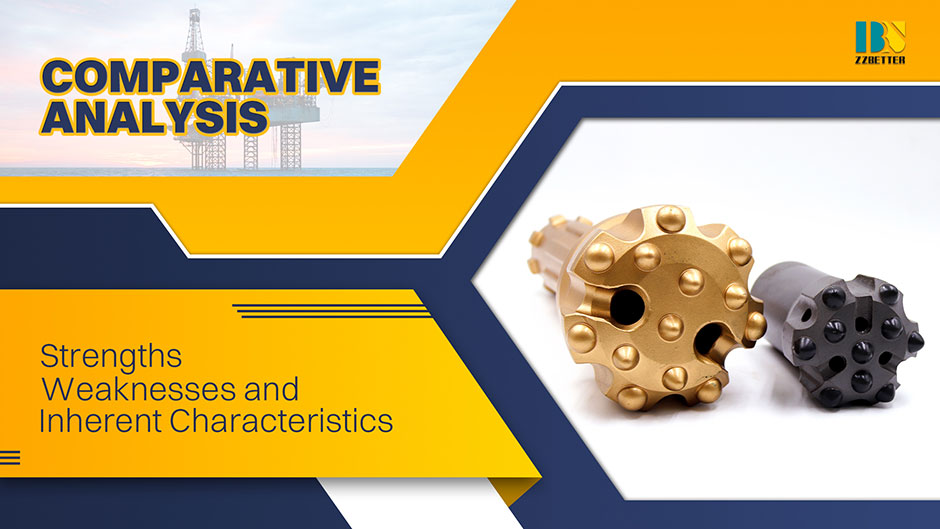
Choosing between DTH and Top Hammer technologies requires a deep understanding of their inherent characteristics, which translate directly into operational strengths and weaknesses. The location of the hammer is not a trivial detail; it defines their performance profile.
Down-The-Hole (DTH) Hammer: The Deep Hole Specialist
Strengths and Advantages:
- Superior Energy Transfer & Straight Holes: Because the hammer strikes the bit directly at the bottom, energy loss is minimal regardless of depth. This not only maintains high penetration rates in deep holes but also produces remarkably straight and accurate boreholes, crucial for precision blasting and well drilling.
- Excellent Performance in Large Diameters: DTH is the undisputed champion for drilling larger holes, typically from 4 inches (100mm) up to 30 inches (750mm) or more. The large-diameter bit has ample space for robust carbide buttons and efficient air flushing.
- Effective Cuttings Removal: The high-volume air flush exits right behind the bit, providing excellent hole cleaning. This is vital in fractured or watery ground, preventing "sticking" of the drill string.
- Reduced Deviation and Wear: With no need to transmit shockwaves up the rods, drill pipe wear is lower, and the system is less prone to deviation in stratified or dipping rock formations.
Weaknesses and Limitations:
- Depth Limitations from Air Supply: While energy transfer isn't an issue, practical depth is limited by the compressor's ability to overcome back pressure and clean the hole. Very deep holes (beyond ~200m in standard setups) require massive compressors.
- Higher Initial Air Power Demand: Operating the hammer and cleaning a large annular hole requires immense air volume and pressure, leading to significant fuel consumption.
- Bit Changing Inefficiency: To replace a worn bit, the entire drill string must be pulled ("tripped") out of the hole. This can be time-consuming for deep holes or frequent bit changes.
-Generally Lower Penetration Rate in Small Diameters: For holes below ~4 inches, the smaller hammer size can make it less efficient than a top hammer in comparable rock.
Top Hammer: The Speed Demon for Shallower Depths
Strengths and Advantages:
- Unmatched Penetration Rate at Shallower Depths: In holes up to ~30 meters (and with modern rigs, efficiently up to 50m), top hammers offer the fastest possible penetration rates in hard rock. The high-frequency impacts from a powerful hydraulic drifter are extremely effective.
- Highly Mobile and Flexible: Rig designs, especially crawler-mounted "jumbos" or compact COP rigs, are incredibly agile, perfect for confined spaces in underground mines, quarries, or construction sites with multiple short holes.
- Efficient Bit Changing: Using a rod changer, the drill string can be extended or retracted quickly. Bit changes only require removing the last rod, not the entire string, speeding up operations.
- Optimal for Small to Medium Diameters: It is the preferred method for drilling holes from 1.5 inches (38mm) to around 5 inches (127mm), common in construction anchoring, small-scale blasting, and bolting.
Weaknesses and Limitations:
- Rapid Energy Loss with Depth: Impact energy attenuates as it travels down the rod string. Beyond a certain depth (around 30-50m for most setups), efficiency drops sharply, making DTH more economical.
- Hole Deviation Issues: The long, flexible rod string can whip and bend, causing hole deviation, especially in layered or soft rock. This requires more guidance and skill from the operator.
- High Rod String Costs and Wear: The rods are subjected to immense fatigue stress. They are expensive, require meticulous maintenance (greasing couplings), and have a finite lifespan, constituting a major operational cost.
- Flushing Challenges in Poor Ground: While air, water, or foam can be used, the flush must travel the entire hole length externally to the rods, which can be less effective than DTH's bottom-up flush in broken ground.
The Core Trade-Off: Depth vs. Speed
In essence, the choice often boils down to a trade-off between penetration rate and depth/large-diameter capability. Top Hammer wins on speed in shallow, small-to-medium holes. DTH wins on depth consistency, accuracy, and large-hole performance.
#drillingspeed #DTHdrilling #tophammerdrillbits #drillingtools #oildrilling
Web: www.drillbetter.com
Email: pdc@drillbetter.com
WhatsApp: +8618173362360