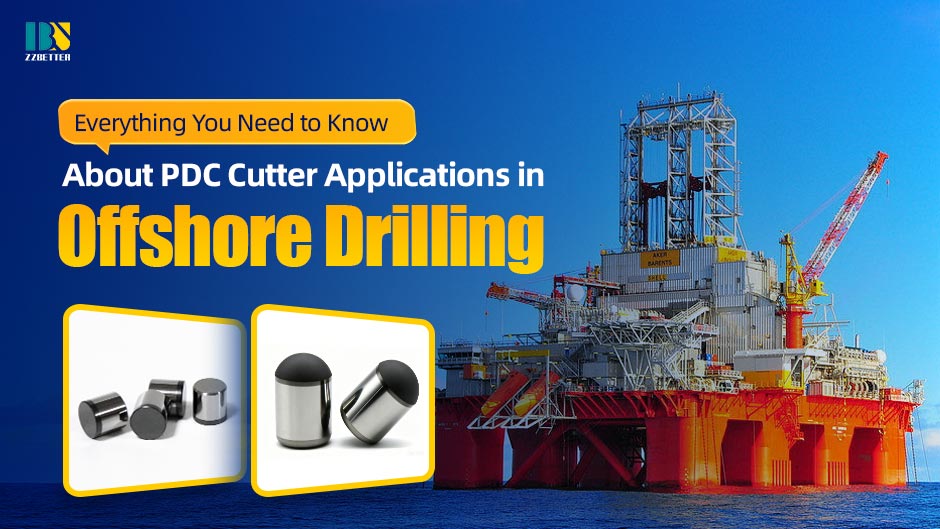
 Offshore drilling is a different game. You are not just drilling a hole. You are drilling a hole that costs $500,000 per day just to keep the rig floating.
That changes how you think about PDC cutters.
On land, you might pull a bit early just to be safe. Offshore, every trip means stopping the drill, pulling miles of pipe, changing the bit, and going back down. That takes 12 to 24 hours. At half a million dollars a day, you do not want to pull a bit unless you absolutely have to.
So the question is not whether a PDC cutter can drill fast. The question is whether it can last long enough to make the trip worthwhile.
Why Offshore Drilling Is Hard on PDC Cutters
Let me list the problems you do not see on land.
- First, longer intervals. Offshore wells often drill through thousands of meters of rock without changing formation. That means one set of cutters has to handle everything from soft shale to hard limestone. A cutter that is perfect for the top section might be useless for the bottom.
- Second, directional drilling. Most offshore wells are not straight. They go down vertically, then bend and go horizontal for kilometers. PDC cutters in directional tools experience side loads they were never designed for. The inside edge of the cutter wears faster. The outside edge chips. Nobody talks about this enough.
- Third, low flow rates. In deep water, you cannot always pump as fast as you want. Marginal flow means poor cleaning. Cuttings stay on the bottom and get re-ground. That wears out cutters twice as fast.
- Fourth, temperature. Deep offshore formations can be hot—150°C or more. Heat kills PDC cutters. The diamond starts turning back into graphite. The bond between diamond and carbide weakens. And you cannot cool the bit properly because flow is limited.
What Offshore Operators Actually Look For
I have sold cutters to offshore contractors in the North Sea, Brazil, and the Gulf of Mexico. Here is what they ask about.
- Durability over speed. They do not care if you can drill 50 meters per hour for two hours. They care if you can drill 10 meters per hour for three days straight. Consistent ROP matters more than peak performance.
- Thermal stability. Flat out, if your cutter cannot handle 200°C downhole, do not bother sending a sample. Offshore buyers will ask for your leaching depth and your thermal testing report. If you do not have one, they will buy from someone who does.
- Impact resistance. Offshore formations are often interbedded. You go from soft shale to hard stringers every few meters. That creates impact load cycles. Cutters that survive impact testing on land still fail offshore because the cycles are more frequent.
Cutter shape matters more than you think
Standard flat cutters work fine in consistent rock. Offshore, you need better geometry.
Chamfered cutters are mandatory. A sharp edge will not survive the first hard stringer. For offshore work, I recommend a 45-degree chamfer at minimum. Some operators are using 60-degree chamfers now. It reduces penetration rate slightly, but it stops chipping.
Oval cutters are becoming popular for horizontal offshore sections. The longer contact area spreads the load across more diamond surface. They cost more to make, but offshore buyers do not care about cutter price. They care about trip cost.
Non-planar interface is not optional anymore. Flat interfaces delaminate under the high torque of offshore motors. If your cutter still has a flat interface, you are selling old technology.
Three offshore formations that destroy cutters
- The North Sea chalk. Chalk is soft but abrasive. It wears down cutters like sandpaper. You need extra thick diamond tables here, at least 2.5mm.
- Brazilian pre-salt. This stuff is hard, thick, and unpredictable. You have carbonate rock, sandstone, and salt all mixed together. The salt also messes with your mud chemistry. Cutters in pre-salt need maximum leaching and maximum impact resistance. Even then, nobody expects to drill the whole interval with one bit.
- Gulf of Mexico deepwater. The problem here is interbedding. You hit hard stringers every few meters. Each stringer chips your cutters a little. After fifty stringers, the cutters are gone. The solution is a very aggressive chamfer and running lower RPM than you think you need.
How offshore drillers run PDC bits differently
On land, drillers push weight and RPM hard until something breaks. Offshore, they are more careful.
- Lower RPM. Most offshore drilling happens at 100 to 140 RPM. High RPM creates heat, and heat offshore is harder to manage because flow is limited.
- Higher weight, but applied carefully. They run heavy weight on bit, but they ease into it. You cannot drop 40,000 pounds on a new bit right away. You step up slowly over the first 50 meters.
- Constant torque monitoring. Offshore rigs have good surface monitoring. If torque starts spiking, it means cutters are chipping or balling. They will back off weight immediately. They do not wait to see what happens.
PDC versus roller cone offshore
This debate is simpler offshore than on land.
Roller cone bits still work. They are tough. They handle interbedded formations well. But they drill slow, and they require more trips because bearings fail.
PDC bits drill faster. The question is whether they survive the whole interval. In many offshore applications, the answer is yes now. Five years ago, maybe not. But cutter technology has improved.
The real shift is in deepwater. Operators used to run roller cones for the bottom section because they did not trust PDCs in hard rock. Now, with leached, chamfered, non-planar cutters, they run PDCs all the way. The drilling time is half what it used to be.
What sells offshore right now
If you want to supply cutters to offshore drillers, here is what you need in your product line.
• A fully leached cutter (minimum 0.5mm leach depth)
• A chamfered edge, preferably 45-degree or steeper
• Non-planar interface certification
• Documentation of thermal stability testing up to 200°C
• A shape option (oval or elliptical) for directional sections
Price is almost never the deciding factor offshore. The buyer is thinking about a $500,000 daily rig cost. If your cutter saves them one trip, you could double your price and they would still save money.
Final advice for offshore buyers
Do not test new cutters on your most expensive well. Run them on a development well first, where you know the formation and you have budget for a trip if something goes wrong.
And do not trust the ROP numbers from land drilling. Offshore is different. Ask for test data from offshore wells. If the supplier does not have it, ask why.
Offshore drilling is not getting easier. The easy oil is gone. You are going deeper, drilling harder rock, and paying more for every hour on location. The right PDC cutter will not solve all your problems, but the wrong one will definitely make them worse.