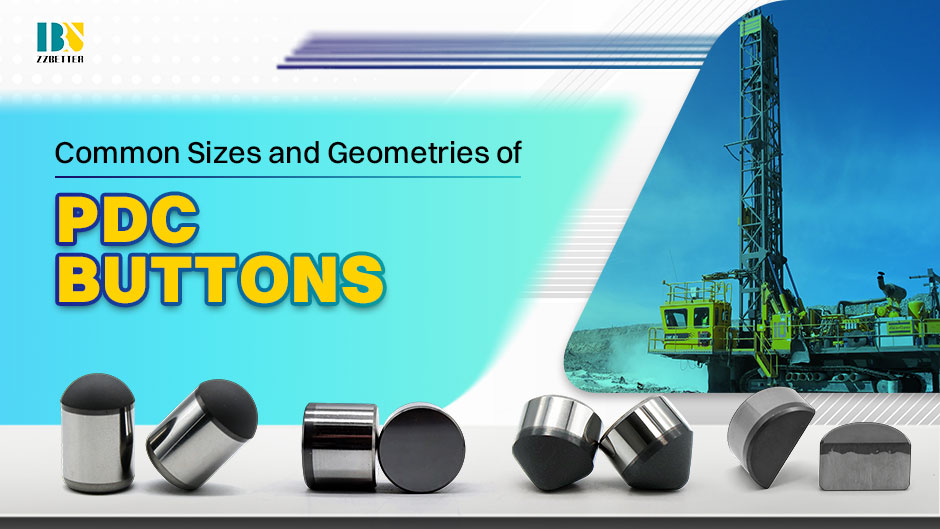
In the world of industrial cutting and drilling, the PDC (Polycrystalline Diamond Compact) button is a marvel of engineered efficiency. However, its performance is not solely defined by the super-hard diamond layer; it is equally governed by its precise physical dimensions and shape. The common sizes and geometries of PDC buttons represent a standardized yet versatile toolbox, allowing engineers to tailor the cutting structure of a tool to specific rock formations and operational demands. Understanding this "blueprint" is key to selecting the right button for the job.
The Critical Dimension: Diameter
The single most defining metric for a PDC button is its diameter, which directly correlates to its wear resistance, impact strength, and cutting aggressiveness. The diameter range caters to a vast spectrum of applications.
● Small Diameters (8mm - 10mm / ≈5/16" - ≈3/8"): These buttons are employed in lighter-duty applications or where precise, fine cutting is required. They might be used in smaller diameter core bits, reaming tools, or for machining non-ferrous composites. Their smaller diamond table volume makes them less suitable for highly abrasive, high-load environments.
● Medium Diameters (13mm - 16mm / ≈1/2" - ≈5/8"): This is the workhorse range for the mining, construction, and water well drilling industries. The 13.3mm (1/2 inch) and 16mm (5/8 inch) buttons are arguably the most common global standards. They offer an optimal balance: sufficient diamond volume for extended wear life in abrasive rock (like sandstone), adequate compressive strength to handle impact in fractured formations, and a proven track record of performance that fits a wide array of bit body designs.
● Large Diameters (19mm+ / ≈3/4" and above): These are the heavyweights, designed for extreme-duty applications. They are specified for large-diameter foundation drill bits, aggressive mining bits in soft to medium formations, and tools where maximizing the wear volume is paramount to minimize downtime. Their larger cross-sectional area provides superior resistance to catastrophic impact failure.
Geometry: The Shape of Cutting Action
Beyond diameter, the geometry of the diamond table—the shape of the button's crown—dictates how it interacts with the rock. The two primary geometries are the dome and the flat-top/cylinder, each with its own performance characteristics.
1.The Dome Button (Spherical Cap): This is the classic and most prevalent PDC button geometry.
● Standard/Shallow Dome: Features a moderately curved spherical surface. This geometry provides an excellent balance between cutting aggressiveness, wear resistance, and mechanical strength. The curved surface promotes a point-load crushing action that initiates cracks in the rock, while the gradual wear exposes fresh diamond, offering a degree of self-sharpening. It is the default choice for rotary drill bits in most formations.
● Tall/Sharp Dome (or Ballistic Dome): Has a more pronounced curvature, resulting in a sharper point. This design is more aggressive, allowing for faster penetration rates (ROP) in softer, less abrasive formations like clay, shale, or soft limestone. However, the sharper point is theoretically more susceptible to chipping under high impact loads, and it contains slightly less wear volume than a standard dome of the same diameter.
2.The Cylindrical/Flat-Top Button: This geometry features a flat or slightly chamfered diamond table atop the carbide substrate.
● Primary Action: It functions primarily through a shearing or planing action rather than point attack. This makes it highly effective in certain stabilized drilling applications or on tools like reamers and stabilizer blocks, where the goal is to smoothly trim the borehole wall or enlarge the hole without excessive gouging.
● Advantage: It presents the maximum possible diamond table surface area for wear, making it extremely durable in purely abrasive, low-impact scenarios. However, it is less effective at initiating fractures in intact rock compared to a dome.
Substrate Configuration: The Foundation Matters
The tungsten carbide substrate also comes in standard configurations that influence assembly and performance:
● Straight Cylinder: The simplest form, commonly brazed into a drilled hole.
● Stepped Substrate: Features a wider base or a step, which allows for mechanical locking into a corresponding socket in the bit body, providing enhanced retention against pull-out forces.
● Tapered or Necked Substrate: Designed to fit into specialized bit blocks, often improving braze joint integrity and heat dissipation.
In conclusion, the common sizes and geometries of PDC buttons are not arbitrary; they are the direct translation of rock mechanics and tool engineering into physical form. Selecting a 16mm standard dome over a 13.3mm tall dome is a calculated decision that balances penetration rate, service life, and application-specific demands. This standardized yet nuanced system enables the creation of highly optimized tools, ensuring that these synthetic diamond "teeth" bite into the earth with maximum efficiency and economy.