For decades, the Polycrystalline Diamond Compact (PDC) cutter has been the workhorse of the drilling industry, celebrated for its ability to shear rock with unmatched efficiency. Yet, as we push the boundaries of exploration into deeper, hotter, and more challenging environments—from ultra-deep geothermal wells to the uncharted territories of lunar coring—a familiar enemy re-emerges: heat.
In conventional PDC cutters, the frictional energy generated at the rock interface doesn't just disappear. Studies have shown that over 50% of the input mechanical energy during drilling is converted into heat . This intense, localized heat accumulation leads to thermal mismatch between the diamond table and its tungsten carbide substrate, causing interfacial stress, delamination, and ultimately, premature tool failure. It is the single greatest threat to cutter life and drilling economics in extreme conditions.
But a groundbreaking advancement in material science is changing the game. A recent study published in Applied Thermal Engineering (February 2026) reveals how "functionally graded" PDC cutters are not just incrementally improving performance—they are fundamentally redefining it.
The Science of the Shift: The Graded Interlayer
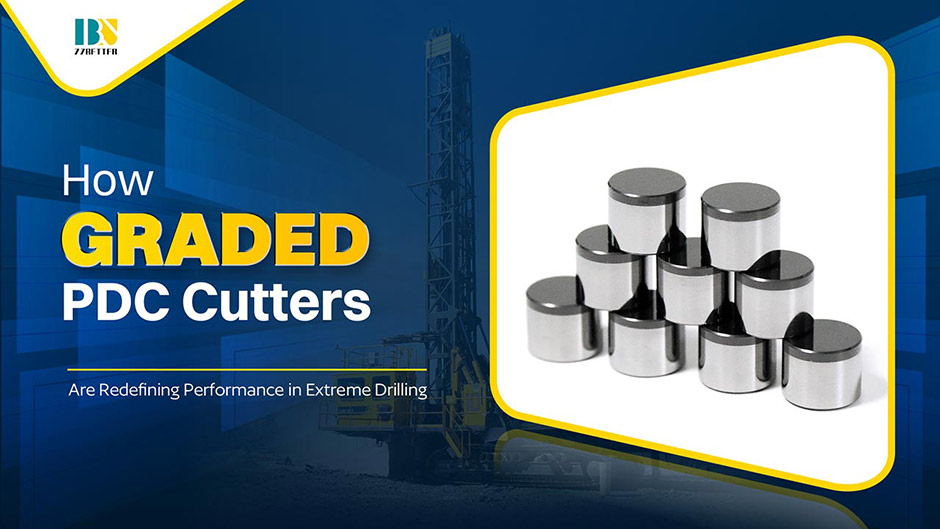
The innovation lies not in the materials themselves, but in their architecture. Traditional PDC cutters feature a sharp, two-layer interface between the polycrystalline diamond (PCD) layer and the WC-Co substrate. This abrupt transition creates a significant thermal resistance barrier, trapping heat in the diamond table where it causes the most damage.
Researchers have now demonstrated the effectiveness of a functionally graded structure. By introducing a compositionally graded interlayer between the PCD layer and the substrate, they have engineered a new heat transfer pathway. This gradient acts as a thermal bridge, systematically reducing interfacial thermal resistance and channeling heat away from the cutting surface more efficiently.
The Data: 25% Cooler, Significantly Better
The results, validated through integrated numerical simulation and experimental testing, are compelling. According to the study, the graded PDC cutter exhibits superior suppression of temperature rise across all tested conditions, including variations in weight on bit (WOB) and rotational speed (RPM).
The most striking finding? Under identical drilling parameters, the graded cutter achieved a thermal equilibrium temperature that was up to 25% lower than its conventional counterpart.
This isn't just about keeping the tool cool. It's about preserving the integrity of the diamond table. By mitigating thermal accumulation, the graded structure directly addresses the root causes of failure—interfacial delamination and micro-crack propagation—thereby extending the operational lifespan of the bit in the most demanding environments.
Why This Matters for the Future of Drilling
The implications of this thermal management breakthrough extend far beyond the oil and gas patch. The research explicitly highlights the technology's relevance for "deep-earth, deep-sea, and deep-space" exploration
• Deep Geothermal: As the world seeks sustainable baseload energy, geothermal drilling requires bits that can survive in crystalline rock formations at temperatures exceeding 300°C. Graded cutters offer a path to faster, more reliable well construction.
• Unconventional Oil & Gas: In shale and tight oil plays, drilling through interbedded, abrasive formations generates extreme frictional heat. A cutter that runs cooler can stay on bottom longer, reducing costly tripping operations.
• Space Exploration: Future missions to the Moon and Mars will require autonomous coring tools to extract pristine samples. The reliability and thermal resilience of graded PDC technology make it a prime candidate for planetary science.
Conclusion
The fight against heat has always been central to drilling optimization. With the advent of functionally graded PDC cutters, we are moving from simply managing heat to engineering our way around it. The 25% temperature reduction reported in this latest research is not just a data point; it is a milestone.
As we continue to drill deeper and reach further, the tools that can "beat the heat" will be the ones unlocking the resources and discoveries of tomorrow.