Surface Mining: The Dominant Force
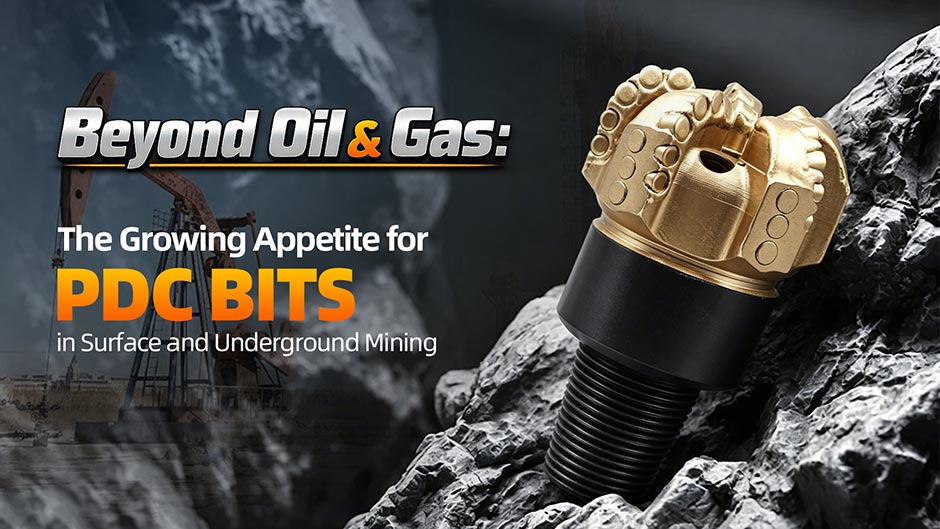
Surface mining, including open-pit operations, quarries, and strip mines, represents the largest share of PDC drill bit consumption in the mining sector today . This dominance is driven by the sheer scale of surface mining operations worldwide and the continuous pressure to improve efficiency.
The Fortune Business Insights report highlights that heavy investment in the mining sector is boosting the surface mining segment. To put this in perspective, industrial data cited in the report shows that investment projects in the surface mining industry accounted for more than 13,000 projects in 2020 alone, valued at approximately USD 1.2 trillion . These are not small operations—they are massive earth-moving enterprises that demand reliable, high-performance drilling tools.
In surface mining, PDC bits are prized for their ability to deliver:
Higher penetration rates compared to traditional roller-cone bits, directly impacting productivity
Longer service life in abrasive formations, reducing the frequency of bit changes
Better hole quality, which improves downstream blasting efficiency
The rotary bit segment, which includes fixed-cutter PDC designs, continues to dominate the market owing to its wide application in mining operations . For operations drilling through overburden or extracting ore in open-pit mines, the economics increasingly favor PDC technology.
Underground Mining: The Fastest-Growing Frontier
While surface mining holds the largest share today, the real story lies underground. Fortune Business Insights identifies underground mining as the fastest-growing segment for PDC drill bits, driven by the expansion of deep and ultra-deep mining projects in recent years .
This growth reflects a broader trend in the mining industry: as easily accessible surface deposits become depleted, operators are going deeper to access valuable mineral resources. Underground mining presents unique challenges that PDC technology is uniquely equipped to address.
The Business Research Company's January 2026 report on mining drill bits reinforces this trend, noting that the market's growth is supported by "rising adoption of advanced pdc and diamond drill bits" and "growth in deep mining and complex geological formations" . These aren't incremental improvements—they represent a fundamental shift in how mining companies approach difficult ground conditions.
Real-World Validation: PDC Performance in Hard Rock
The theoretical advantages of PDC bits in mining are being validated in real-world operations. Consider the case of Stawell Gold Mines in Victoria, Australia, where operators faced an exceptionally challenging geological formation—a magnetite-rich banded unit they call the "BIF" (banded iron formation).
According to mine superintendent Mark Nellthorp, the ground was so hard that experienced operators were "getting just a few meters out of a drill bit before it was completely destroyed" using conventional bits . Enter polycrystalline diamond (PCD) technology—the same fundamental material science that powers PDC bits.
During trials of Epiroc's Powerbit X drill bits—which feature tungsten carbide buttons coated with a wear-resistant PCD formula—the results were dramatic. While standard bits managed only about 7 meters in this punishing ground, the first PCD-equipped bit trialled achieved an exceptional 400 meters .
This isn't just about longevity. The mine superintendent emphasized that "if we can drill more meters, more effectively, and get our costs down, that's the direction we want to take" . The productivity gains extended beyond the bit itself: fewer bit changes meant less downtime from pulling rods, reduced wear and tear on drill rigs, and even safety benefits from less operator exposure to the drilling area .
Innovation Beyond Drilling: Tunnel Development
The application of PDC technology in mining extends beyond traditional blast-hole drilling. A strategic partnership between Element Six (a De Beers Group company) and Master Drilling announced in early 2025 demonstrates how synthetic diamond technology is revolutionizing tunnel development for mining access .
Their novel diamond-enabled cutting system uses advanced PCD cutting tools to create precise cut slots in rock, which act as fracture initiation zones. This allows the rock to break with lower energy input in a secondary step . The benefits are compelling:
- 17% reduction in waste rock generation compared to traditional tunneling operations
- Ability to handle soft to ultra-hard and high-strength rock removal
- Higher productivity rates and longer cutter life
- Energy-efficient operation consuming just 70 kW of power
- Safer working conditions by eliminating blasting and diesel requirements
As Element Six's Dr. Habib Saridikmen notes, "Diamonds, with their exceptional hardness, high thermal conductivity, and low friction coefficient, outperform traditional materials in cutting hard and high-strength rocks" . This is the same value proposition driving PDC adoption across mining applications.
Want to know more about PDC and PDC bits, feel free to contact via following methods:
Email: pdc@drillbetter.com
WA: wa.me/8618173362360
Web: www.drillbetter.com
#pdcbits #pdccutter #pdctechnology #mining #drilling #oilandgas #surfacedrilling