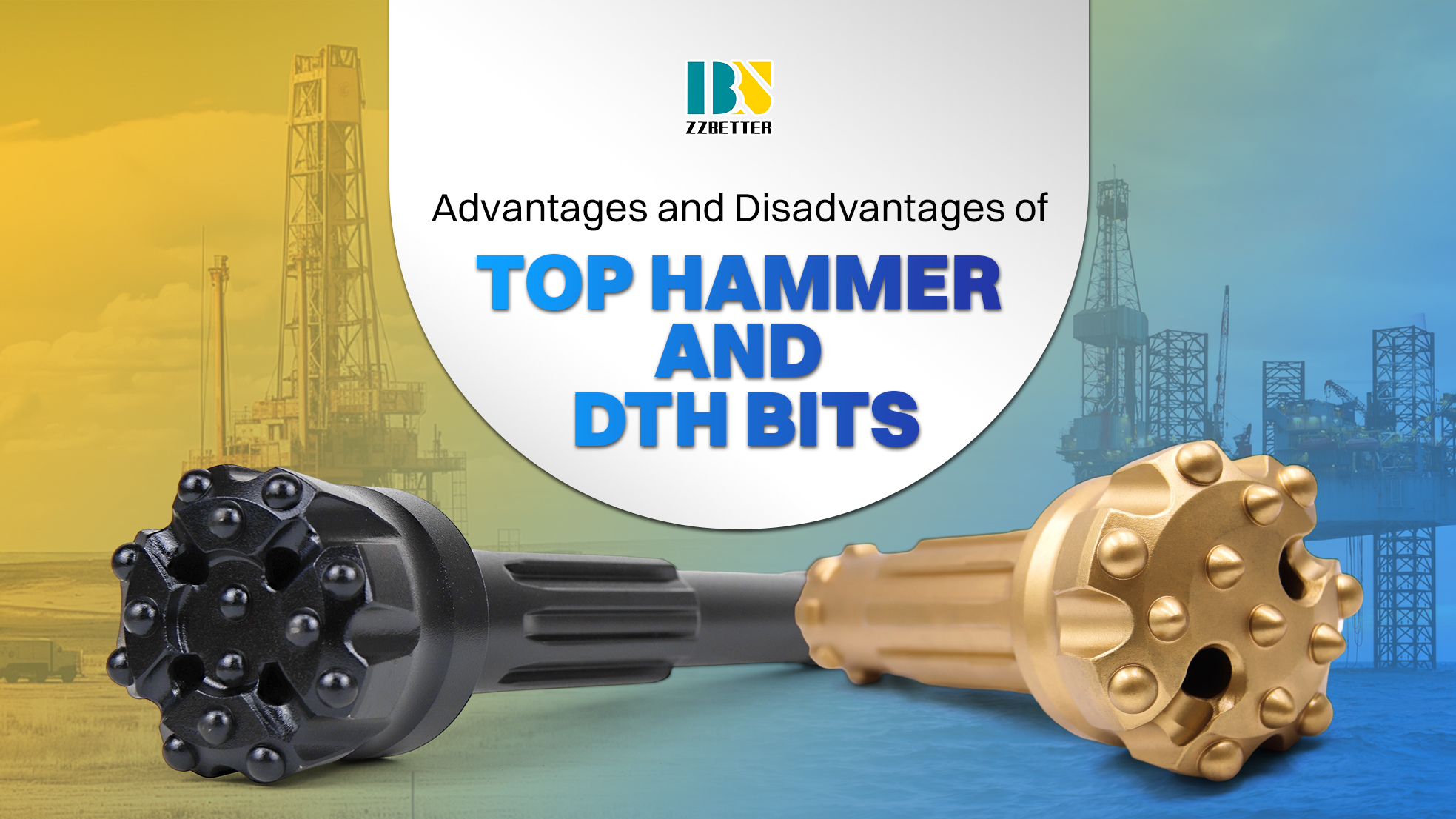
Advantages and Disadvantages of Top Hammer
Top Hammer Advantages
● Lower upfront equipment cost.
● Faster drilling speed in shallow holes.
● Smaller, more portable rigs are ideal for tight or hard-to-reach sites.
Tip: For short-term construction or quarry work** where speed and mobility matter more than precision, Top Hammer will save you time and money.
Top Hammer Disadvantages
● Accuracy decreases and hole deviation increases with depth.
● Significant rod and coupling wear, requiring frequent replacement.
● Less effective in very hard or fractured rock.
Tip: If you need to drill deeper than 30 meters, or hole straightness is critical, consider switching to DTH to avoid rework.
Advantages and Disadvantages of DTH
DTH Advantages
● Produces straighter, cleaner holes at depth.
● Handles hard, fractured, or abrasive rock well.
● Suitable for large-diameter drilling.
Tip: For deep drilling or precision drilling projects, DTH delivers better long-term value, despite higher operating costs.
Related Read: Which Drill Bit Stays Sharp Longer?
DTH Disadvantages
● Higher operating costs due to compressor fuel consumption.
● Less efficient than TH in softer ground or shallower holes.
● Heavier equipment and more complex maintenance.
Tip: Always calculate the cost per meter drilled. For shallow projects, TH may be more efficient; for deep projects, budget higher for DTH fuel and maintenance costs.
Key Factors to Consider
Hole Depth and Straightness
Top Hammer is suitable for shallow to medium depths, while DTH provides precision at greater depths.
Step: Define the maximum hole depth and required straightness. For deeper, more precise holes, choose DTH.
Rock Type and Geology
Top Hammer works well in medium-hard formations, while DTH is better for fractured, very hard, or abrasive rock.
Step: Review geological data. If rock strength exceeds approximately 200 MPa, DTH will be more efficient.
Cost and Budget
TH has lower upfront costs but higher consumable costs. DTH has higher fuel and setup costs but can avoid rework in deep/harsh conditions.
✔Step: Run a lifecycle cost analysis**—(fuel + tool wear + downtime) ÷ meters drilled—to get a true cost per meter.
Productivity and Efficiency
TH offers faster penetration rates in shallow applications, while DTH maintains consistent efficiency in deep applications.
✔Step: Align the drilling method with the project schedule. For numerous shallow holes, choose TH; for fewer deep holes, choose DTH.
Maintenance and Tool Life
TH requires regular rod inspection; DTH requires compressor maintenance and lubrication.
✔Step: Track downtime costs. If rod failure is too frequent, upgrade consumables or switch to DTH; if compressor costs are too high, optimize the setup.
Environmental and Safety Considerations
TH generates more noise/vibration; DTH consumes more fuel but is quieter for the operator. Both generate dust.
✔Step: Check local site regulations. For sites with emission rules, choose TH; for areas with strict noise limits, choose DTH.
Operator Skills and Training
TH is easier to learn, while DTH requires experience with compressors and hammer maintenance.
✔Step: Assess your crew's skills. If you lack DTH experience, allocate a training budget or hire experienced operators.
Logistics and Site Accessibility
TH rigs are lighter and more mobile; DTH requires heavy compressors.
✔Step: Evaluate site access. If the terrain is challenging, TH may be more practical.