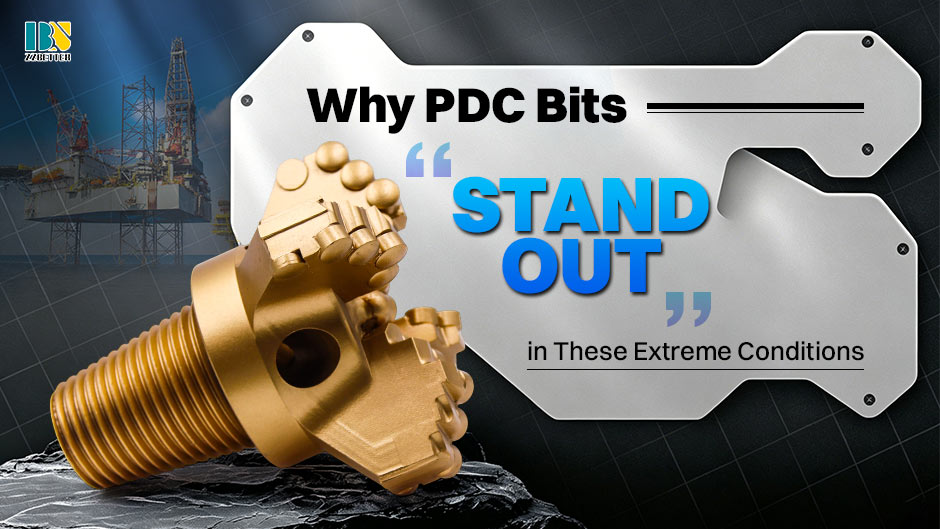
This is a highly important issue in fields such as oil drilling, geological exploration, and tunnel boring. Polycrystalline-diamond-compact (PDC) cutter wear is a system-level problem. Failure seldom has a single cause; it is the convolution of three driver groups:
1.Formation drivers (lithology you must drill)
2.Cutter drivers (material you can engineer)
3.Operational drivers (parameters you can control)
Understanding how these groups interact is the only route to predictable bit life and cost per foot.
1.Formation Drivers – “What you are drilling”
Rock Strength & Quartz Content
• Unconfined compressive strength (UCS) > 150 MPa accelerates mechanical abrasion exponentially.
• Quartz is the dominant abrasive: Mohs 7 versus cobalt binder ~Mohs 5. Every 10 % increase in quartz above 40 % typically doubles wear rate.
• Angularity & cementation matter: coarse, euhedral, tightly cemented quartz grains cut like 600-grit sandpaper; rounded, loosely cemented grains behave like 200-grit.
Heterogeneity & Dynamic Loading
• Alternating hard/soft streaks, chert nodules or natural fractures introduce impact loads 5-10× the mean WOB. These impulses nucleate micro-chipping that pre-conditions the diamond table for macro-fracture.
• Lateral and torsional vibration (stick-slip) convert cutter loading from pure shear to impact fatigue—the #1 root cause of premature PDC failure worldwide.
2.Cutter Drivers – “What you built”
Diamond Table Architecture
• Grain size: 10–20 µm fines give high initial wear resistance but low fracture toughness; 50–100 µm coarse grades trade 10 % wear resistance for 30 % higher impact strength. Gradient or multi-modal designs capture both benefits.
• Defect density: every 1 % residual porosity or metallic inclusion reduces wear life ~8 %. High-pressure high-temperature (HPHT) sintering ≥7 GPa / 1 400 °C is now standard for premium cutters.
Interface Engineering
• A 2-D sinusoidal interface increases shear strength 25–40 % versus flat interface; 3-D “non-planar” or “chevron” geometries push delamination pressure > 1 000 MPa.
• Transition layers (diamond volume fraction stepped from 100 % to 60 % over 0.5 mm) reduce residual stress by 30 %.
Thermal Stability Treatments
• Cobalt catalyzes graphitization above ~350 °C in vacuum/air. Acid leaching (TST) to ≤0.2 wt % free cobalt extends oxidation threshold from 750 °C to 1 200 °C and doubles cutter life in geothermal or high-RPM applications.
• Post-HPHT anneal (1 100 °C / 30 min / Ar) relieves 60 % of residual compressive stress without strength loss.
Edge Preparation & Macro-Geometry
• 0.010–0.020 in (0.25–0.50 mm) × 45° chamfer raises chipping threshold 3× in interbedded formations.
• Mirror polish (Ra ≤ 0.05 µm) lowers frictional coefficient 15 % and reduces interface temperature ~30 °C at equal ROP.
• Conical or “bull-nose” shapes shift load from shear to compression; life improvements of 5-10× demonstrated in highly fractured carbonates.
3.Operational Drivers – “How you drill”
Mechanical Specific Energy (MSE) Balance
• Sweet-spot WOB delivers MSE ≈ 1.5× rock UCS. Below this, bit whirl and re-grinding dominate; above it, thermal and impact damage accelerate.
• Rotary speed: every 100 rpm increase raises cutter temperature ~25 °C in water-based mud; above 350 °C TST cutters begin to lose advantage.
Hydraulic Horsepower at the Bit
• Minimum 2.5 HHP/in² (0.4 kW/cm²) nozzle pressure drop is required to keep cutter face temperature < 250 °C in 150 °C bottom-hole temperature.
• Junk-slot area ≥ 40 % of total bit profile prevents cuttings re-circulation and bit balling in plastic shales.
Bottom-Hole-Assembly (BHA) Stability
• Place the first string stabilizer within 30 ft (9 m) of bit; keep lateral acceleration < 50 g RMS. Above this threshold, impact fatigue dominates wear mode within minutes.
• Torsional oscillation: keep surface torque variation < 15 % of mean. A shock-sub or rotary-steerable with active damping reduces PDC chipping rate 60 %.