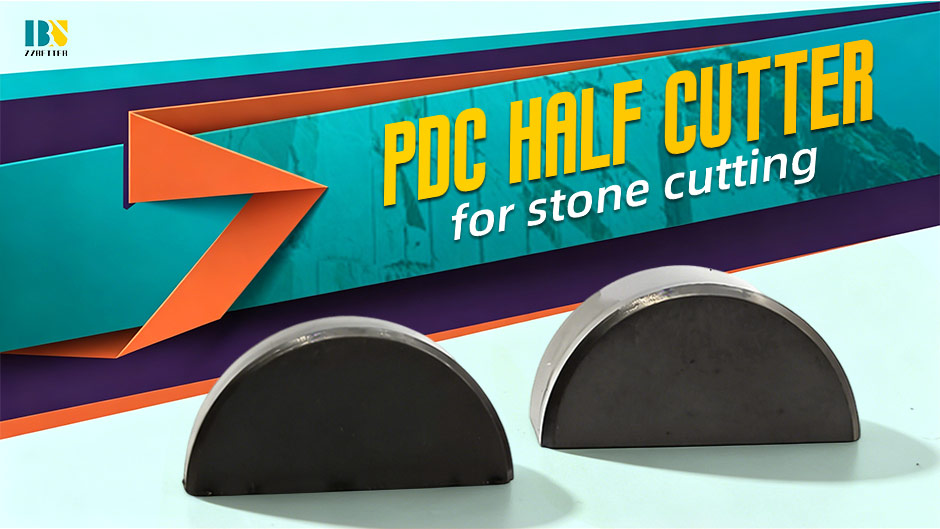
 As a technician at a diamond-tool factory, I will describe the typical PDC (polycrystalline diamond compact) half-cutter used for stone cutting: its common sizes, the markets where it is used, and the main types of equipment that use this kind of composite cutter.
Typical construction and dimensions
The PDC half-cutter is a semi-disc (half‑round) or half‑moon shaped insert consisting of a polycrystalline diamond table sintered onto a tungsten‑carbide substrate. For stone cutting applications the diamond table and substrate thicknesses are selected to balance cutting life and resistance to impact and thermal shock.
· Typical diamond table thickness: 0.3–2.0 mm. Harder, highly abrasive engineered stones often require a thicker diamond table toward the upper end of this range.
· Typical substrate (WC-Co) thickness: 1.0–5.0 mm. Thicker substrates (3–5 mm) are common for heavy duty gang saw segments and large circular blades to resist deformation and heat.
· Usual overall diameters (full‑disc equivalent): 6–30 mm (thus half‑cutters are the corresponding half shapes). For stone fabrication smaller inserts (6–12 mm) are common in profiling and finishing tools, medium sizes (12–18 mm) for general bridge saw and circular blade segments, and larger sizes (18–30 mm) for heavy industrial gang saws and high‑output block cutters.
· Bond and mounting face: the flat back of the half cutter is prepared for brazing, silver‑soldering, vacuum braze or for embedding into a sintered steel/bronze segment matrix. Geometry (cutting face angle, rake, clearance) is customized by application.
Main application markets
· Natural dimension stone: granite, gneiss, basalt quarrying and block‑to‑slab sawing where high wear resistance and edge life are critical.
· Marble and limestone: for fast, cleaner cuts with reduced heat and chipping.
· Engineered stone and quartz agglomerates: very abrasive materials that benefit from PDC’s hardness and thermal stability.
· Stone fabrication and countertop workshops: bridge saws, circular saw blades and segment replacements.
· Large‑scale processing facilities and quarries: gang saws, multi‑blade saw lines and block cuttings where downtime reduction and tool life directly affect cost per square meter.
Infrastructure and construction contractors working with precast or dimensional stone.
Main equipment using PDC half cutters
· Gang saws / multi‑blade frames: PDC half cutters are commonly embedded into segments of gang saw blades for high‑volume slab production.
· Bridge saws and circular blade systems: segments for industrial bridge saws and diamond circular blades often use PDC half cutters to improve segment life and cutting speed.
· Block cutters and stationary circular saws: heavy duty saws that cut stone blocks to slabs use larger, thicker PDC inserts.
· Profiling and CNC stone routers: smaller PDC half cutters are used for trimming and edge profiling where controlled geometry is required.
· Portable & floor saws (in some applications): where brazed PDC segments replace conventional diamond segments for longer life.
Note: PDC half cutters are typically mounted into a metallic segment matrix (sintered or brazed). They are not used on wire‑saw beads; wire saw technology uses diamond beads or fixed synthetic diamond impregnation.
Selection guidance
For very hard granite and abrasive engineered stone choose larger diameter and thicker table/substrate PDC half cutters.
For thin finishing or profiling work choose smaller diameter, thinner table cutters with optimized cutting face geometry.
Discuss mounting method (brazed vs sintered) and cooling requirements with your supplier to avoid thermal damage and ensure long life.
In summary, PDC half cutters provide excellent wear life and stable cutting performance across the full range of stone markets. Proper size, diamond table thickness and mounting method must be chosen to match the machine type and the stone material for optimal productivity and cost efficiency.