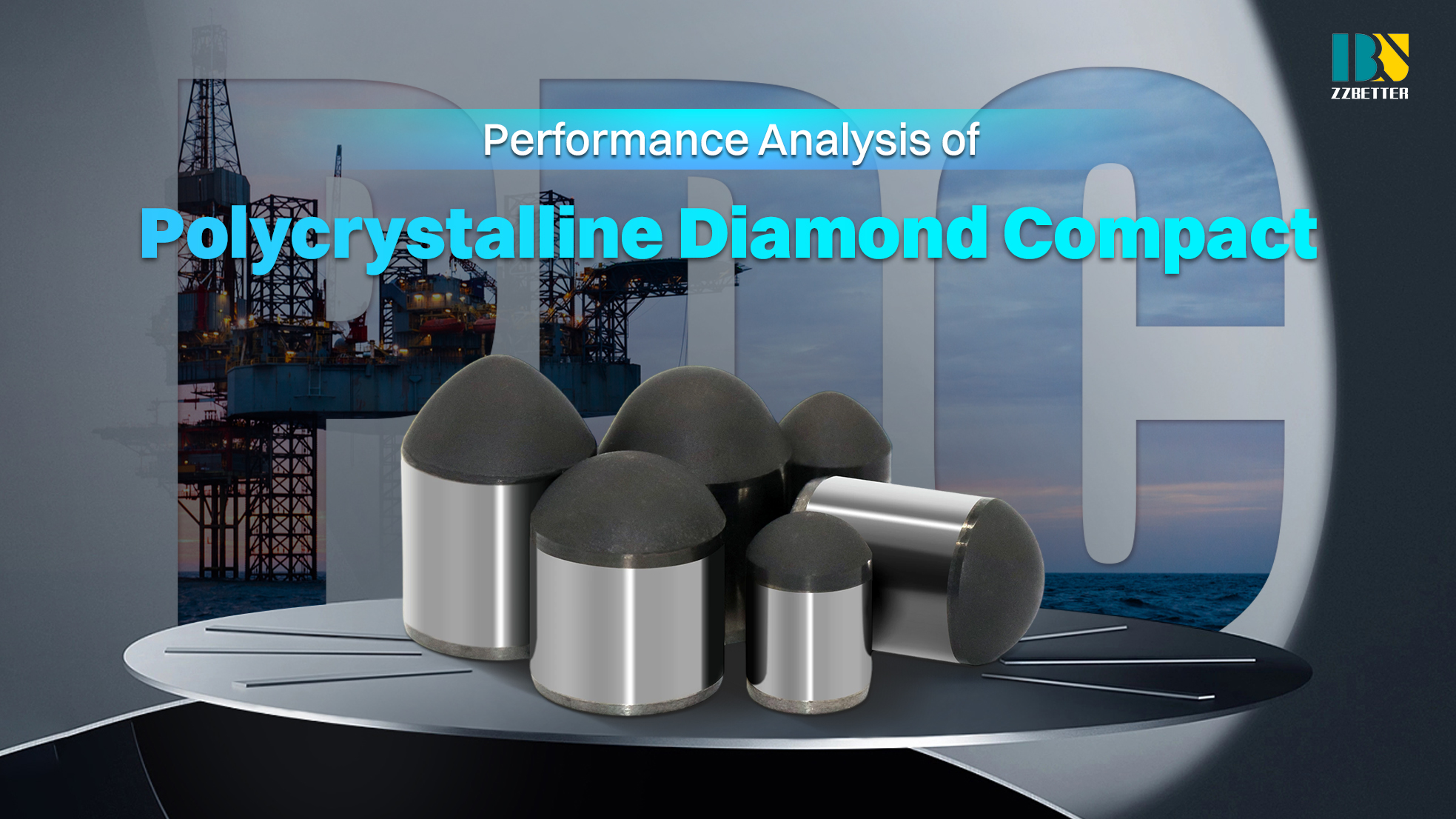
A Polycrystalline Diamond Compact (PDC) is sintered from diamond micro-powder and a carbide substrate under ultra-high pressure and high temperature. It combines the high hardness, high wear resistance, and thermal conductivity of diamond with the strength and impact resistance of cemented carbide, making it an ideal material for manufacturing cutting tools, drilling bits, and other wear-resistant tools.
It is a composite material composed of diamond and a carbide substrate, characterized by high hardness and excellent wear resistance. It is widely used in oil drilling, geological exploration, coal mining bits, mechanical cutting tools, and other industries.
Polycrystalline Diamond Compact (PDC) is widely used in modern industrial society primarily because it possesses unparalleled superior properties compared to other materials. Today, we will analyze the exceptional performance of PDC:
First, extremely high hardness and wear resistance (wear ratio).
The hardness of PDC reaches approximately 10,000 HV, making it the hardest artificially produced material in the world, significantly harder than cemented carbide and engineering ceramics. Due to its extreme hardness and isotropic nature, PDC offers excellent wear resistance. Generally, the wear ratio is used to reflect the wear resistance of PDC. From the 1980s to the mid-1990s, the wear ratio of PDC was 40,000–60,000 (while internationally it was 80,000–120,000). From the mid-1990s to the present, the wear ratio of PDC has improved to 80,000–300,000 (internationally, it ranges from 100,000 to 500,000).
Second, PDC demonstrates thermal stability.
The thermal stability of PDC determines its range of applications. The thermal stability, or heat resistance, of PDC is one of the critical performance indicators used to evaluate its quality, alongside strength and wear ratio. Thermal stability refers to the chemical stability of the polycrystalline layer (the degree of diamond graphitization), changes in macroscopic mechanical properties, and the impact on the bonding strength at the composite layer interface after heating to a certain temperature in an atmospheric environment (with oxygen present) and subsequent cooling. After sintering at 750°C, the thermal stability of some domestic products shows a 5%–20% increase in wear ratio with little change in impact toughness, while other domestic products exhibit a decrease in both wear ratio and impact resistance. These variations are related to the different formulations and processes adopted by manufacturers. In contrast, internationally produced PDC shows minimal changes in wear ratio and impact toughness before and after sintering.
Additionally, PDC possesses impact toughness.
As a cutting tool, PDC is widely used in oil and gas drilling operations. During drilling, factors such as the combined action of axial force and horizontal cutting force, friction between the drill tool and the borehole wall, bending of the drill string, uneven bottom holes, residual rock powder, and drill rig vibrations subject the PDC on the drill bit to significant impact forces. The impact resistance of PDC reflects its toughness and bonding strength, serving as a comprehensive indicator and a key factor determining its performance. From the 1980s to the mid-1990s, the impact toughness of PDC was 100–200 J (internationally, it was 200–300 J). From the mid-1990s to the present, the impact toughness has improved to 200–400 J (internationally, it exceeds 400 J).
Current development directions for PDC mainly include:
1.Increasing the thickness of the polycrystalline diamond layer, this has grown from the initial less than 1mm to 2-4mm now, thereby increasing product service life.
2.Using progressively finer diamond grains, improving the comprehensive performance of wear resistance and impact resistance.
3.Enhancing thermal stability by optimizing processes or employing techniques like cobalt removal and adding heat-resistant layers.
4.Optimizing the interface structure to improve interfacial stress.
5.Increasing the product diameter to improve synthesis efficiency.
6.Improving the sintering effect to reduce performance variations.